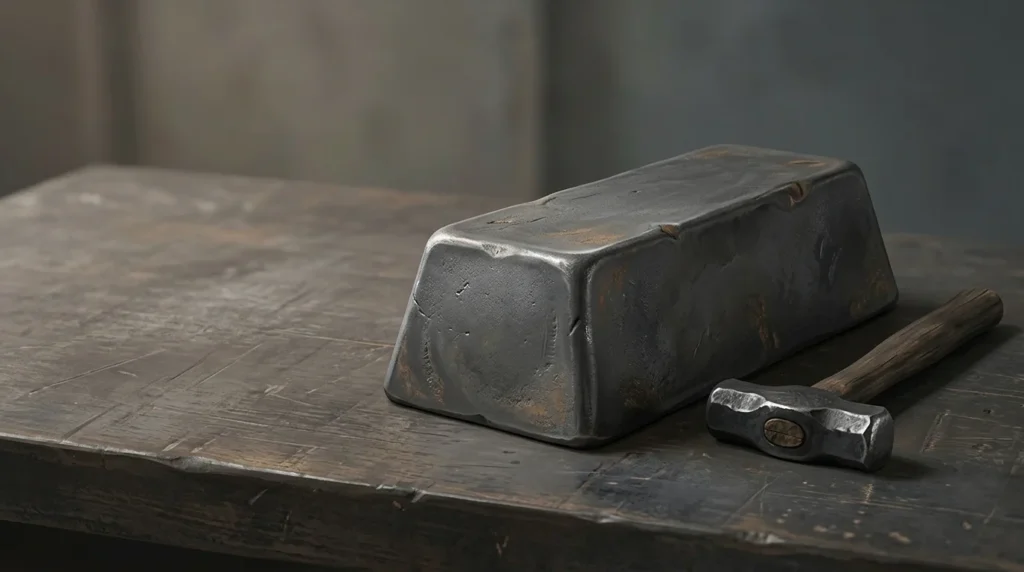

The best synonym for iron depends on how the word is used. When referring to the metal, metal is a broad alternative, while steel is a related material but not an exact synonym. When describing someone as having an “iron will,” words such as unyielding, resolute, and steadfast can express similar qualities. In expressions such as “iron out a problem,” alternatives include resolve, settle, and smooth out.
Iron has several meanings in English, so there is no single replacement that works in every sentence. Understanding the context helps you choose a word that preserves the intended meaning.
What Are the Best Synonyms for Iron?
Here are useful alternatives grouped by the meaning of iron.
| Meaning of iron | Synonyms or alternatives | Important distinction |
|---|---|---|
| The chemical element or metal | Metal, metallic material | Metal is broader than iron, not an exact equivalent. |
| Iron used in construction or manufacturing | Ferrous metal, iron material | Ferrous refers to iron or, in technical usage, materials containing iron. |
| A strong, firm quality | Unyielding, firm, resolute | These describe strength or determination rather than the metal itself. |
| Determination or willpower | Steadfast, unwavering, resolute | Best for figurative expressions such as “an iron will.” |
| Strict control or discipline | Rigid, strict, firm | These can imply inflexibility, depending on context. |
| To remove wrinkles from clothing | Press, smooth | Press is often a natural alternative to using an iron. |
| To resolve a difficulty | Resolve, settle, smooth out | These work in the expression “iron out a problem.” |
| An iron used for clothing | Clothes iron, pressing iron | These are descriptive names for the appliance. |
The most accurate choice depends on whether iron refers to a material, a quality, a household appliance, or an action expressed in an idiom.
What Does Iron Mean?
Iron is primarily a noun referring to a chemical element and a metal. Its chemical symbol is Fe. It is widely used in industry, construction, machinery, and manufacturing, although many everyday objects described as iron are actually made from iron alloys or other materials.
The word also appears as a verb and in figurative expressions.
1. Iron as a Metal
Iron is a metallic chemical element used in many industrial applications. It is an essential component of steel, which is made primarily from iron and carbon.
Example: The old gate was made of iron.
In this context, metal is a broader category rather than a precise synonym. Steel may be relevant when discussing a particular iron-based alloy, but the two materials are not identical.
2. Iron as a Symbol of Strength
Iron is often used figuratively to suggest firmness, toughness, discipline, or determination.
Example: Despite repeated setbacks, she maintained an iron will.
Here, iron does not refer literally to the metal. It emphasizes an exceptionally strong and unwavering attitude.
3. Iron as a Household Appliance
An iron is an appliance used to remove wrinkles from clothing, usually with heat.
Example: He used an iron to press his shirt before the interview.
In this sense, clothes iron and pressing iron are clearer descriptive alternatives. The word press may replace iron when describing the action.
4. Iron as a Verb
To iron clothing means to remove wrinkles by applying heat and pressure.
Example: She ironed her uniform the night before school.
Depending on the sentence, press or smooth may communicate a similar action. However, smooth is broader and does not necessarily imply the use of a heated appliance.
5. Iron in the Expression “Iron Out”
The phrasal verb iron out means to resolve a problem, disagreement, or difficulty.
Example: The team met to iron out the remaining issues before the launch.
In this context, resolve, settle, and smooth out are natural alternatives.
For more helpful explanations, check out our guide to For more helpful explanations, check out our guide to Commonly Confused English Words
Synonyms for Iron Explained in Detail
The following alternatives cover the main literal and figurative uses of iron. Some are close equivalents in a specific sentence, while others describe a related material or quality.
1. Metal
Meaning: A broad category of materials that are generally hard, conductive, and capable of being shaped.
Metal is useful when the exact material is unknown or unimportant.
Example: The workshop uses metal to manufacture durable tools.
Difference from iron: Iron is one specific metal. Replacing iron with metal removes that specificity, so it is suitable only when the precise material does not matter.
2. Steel
Meaning: An alloy made primarily from iron and carbon, often with other elements added to achieve particular properties.
Steel is relevant when discussing construction, machinery, tools, and structural materials.
Example: The bridge was built using high-strength steel.
Difference from iron: Steel is not an exact synonym for iron. Pure iron and steel have different compositions and properties. Use steel only when the material being described is actually steel.
3. Ferrous Metal
Meaning: A metal or metal-based material containing iron, especially in technical or industrial contexts.
Example: The recycling facility separates ferrous metals from non-ferrous materials.
Difference from iron: Ferrous metal is a broader technical category. It includes iron and many iron-containing alloys, including most steels.
Best context: Manufacturing, engineering, construction, and recycling.
4. Unyielding
Meaning: Not giving way to pressure, persuasion, or opposition.
Unyielding is useful when iron describes firmness or determination.
Example: Her unyielding commitment helped the team finish the project despite serious obstacles.
Difference from iron: Unyielding directly describes a quality of firmness. It can suggest admirable determination, but it may also imply stubbornness.
Best context: Determination, resistance, principles, and persistence.
5. Resolute
Meaning: Firmly determined to do something.
Resolute is particularly suitable for describing someone who remains committed to a decision or goal.
Example: The director remained resolute in her decision to protect the employees.
Difference from iron: Resolute emphasizes deliberate determination, while figurative iron can suggest exceptional strength or toughness more broadly.
Best context: Professional writing, leadership, decisions, and personal determination.
6. Steadfast
Meaning: Firmly committed, loyal, or consistent despite difficulties.
Example: His steadfast support helped the organization through a difficult period.
Difference from iron: Steadfast often emphasizes reliability and loyalty over time. It is not always as forceful as the image of an “iron will.”
Best context: Loyalty, commitment, beliefs, and long-term support.
7. Unwavering
Meaning: Remaining firm and consistent without hesitation or weakening.
Example: She showed unwavering confidence throughout the negotiations.
Difference from iron: Unwavering emphasizes consistency and a lack of doubt. It is particularly natural with nouns such as support, confidence, commitment, and determination.
Best context: Confidence, support, commitment, and resolve.
8. Firm
Meaning: Strong, steady, or not easily changed.
Firm is a versatile alternative when iron describes a strong position, rule, decision, or grip.
Example: The manager took a firm stance on workplace safety.
Difference from iron: Firm is generally less intense and more neutral than figurative iron. It can communicate strength without suggesting extreme rigidity.
Best context: Decisions, rules, boundaries, positions, and control.
9. Rigid
Meaning: Stiff, inflexible, or unwilling to change.
Rigid can replace iron in some contexts involving strict rules or inflexible control, but it often carries a negative connotation.
Example: The company struggled under a rigid approval process.
Difference from iron: Rigid emphasizes a lack of flexibility. An “iron will” may be admirable, whereas a rigid attitude often suggests an inability to adapt.
Best context: Rules, systems, attitudes, and procedures.
10. Strong
Meaning: Having physical power, firmness, influence, or resilience.
Example: She has a strong sense of responsibility.
Difference from iron: Strong is broader and less vivid than iron. It works well when clarity is more important than expressive force.
Best context: Character, physical ability, arguments, relationships, and determination.
11. Tough
Meaning: Strong enough to withstand difficulty, pressure, or damage.
Example: The team faced a tough challenge during the final stage of the project.
Difference from iron: Tough emphasizes the ability to endure hardship. It is more conversational than resolute and does not necessarily imply determination or inflexibility.
Best context: People, conditions, challenges, materials, and difficult decisions.
12. Strict
Meaning: Requiring rules or standards to be followed closely.
Example: The school maintains strict safety rules in its science laboratories.
Difference from iron: Strict focuses on enforcing rules or standards. It may be appropriate for an expression such as “iron discipline,” but it does not capture every meaning of figurative iron.
Best context: Discipline, regulations, supervision, and procedures.
13. Unbreakable
Meaning: Not able to be broken, damaged, or defeated easily; often used figuratively for a powerful bond or determination.
Example: The two friends formed an unbreakable bond during their years of working together.
Difference from iron: Unbreakable emphasizes resistance to damage or defeat. It is often more absolute than strong and may be figurative rather than literal.
Best context: Bonds, determination, confidence, and resilience.
14. Press
Meaning: To apply pressure, or to remove wrinkles from clothing using a heated appliance.
Example: He pressed his trousers before leaving for the ceremony.
Difference from iron: Press is a natural verb alternative to iron when discussing clothing care. It can also refer to other actions involving pressure, so the context must be clear.
Best context: Clothing care and fabric finishing.
15. Smooth Out
Meaning: To make something smoother or to resolve a difficulty.
Example: The project manager arranged another meeting to smooth out the disagreements.
Difference from iron: Smooth out can replace iron out in many figurative situations, especially when resolving differences or difficulties. It can also refer to physically smoothing a surface.
Best context: Disagreements, practical problems, plans, and processes.
16. Resolve
Meaning: To find a solution to a problem or settle a difficult matter.
Example: The two departments worked together to resolve the scheduling conflict.
Difference from iron: Resolve directly communicates solving the problem. Iron out often suggests dealing with smaller remaining details or difficulties within a broader plan.
Best context: Problems, disputes, conflicts, and outstanding issues.
17. Settle
Meaning: To reach an agreement, resolve a disagreement, or bring a matter to a conclusion.
Example: The partners settled their disagreement before signing the contract.
Difference from iron: Settle often emphasizes reaching an agreement or bringing a dispute to an end. It is not a suitable replacement when iron refers to a metal or appliance.
Best context: Disputes, negotiations, disagreements, and arrangements.
18. Smooth
Meaning: Having an even surface or proceeding without difficulty.
Example: The new process helped ensure a smooth transition to the updated system.
Difference from iron: Smooth describes a quality or condition, whereas iron out describes the action of resolving difficulties. It is therefore a context-dependent alternative, not a direct synonym in every sentence.
Best context: Surfaces, transitions, operations, and experiences.
Also Read: Synonyms of Tendrils
Synonyms for Iron by Context
Choosing an appropriate alternative becomes easier when you identify the meaning of the original sentence.
Iron as a Symbol of Determination
Expressions such as iron will, iron resolve, and iron determination use iron to suggest exceptional strength.
Useful alternatives include:
- Resolute: firm in a decision or purpose.
- Unwavering: consistent and not weakened by doubt.
- Steadfast: committed and reliable over time.
- Unyielding: unwilling to give way to pressure.
- Strong-willed: determined to pursue one’s own decisions or goals.
For example:
- Original: “She showed iron determination during the recovery process.”
- Alternative: “She showed unwavering determination during the recovery process.”
Both sentences describe persistence. Unwavering emphasizes consistency, while iron gives the expression a more forceful, vivid quality.
Iron as a Symbol of Authority or Discipline
When iron describes strict control, firm leadership, or disciplined behavior, the best alternative depends on whether the tone is positive, neutral, or negative.
- Firm: strong but potentially fair and reasonable.
- Strict: requiring close compliance with rules.
- Rigid: inflexible, often with a negative implication.
- Uncompromising: unwilling to change a position or make concessions.
For example:
- “The organization operated under iron discipline.”
- “The organization operated under strict discipline.”
The second sentence is more direct and neutral. By contrast, “rigid discipline” suggests that the rules may be excessively inflexible.
Iron as a Material
When discussing iron as a physical substance, precision matters more than stylistic variety.
Useful related terms include:
- Metal: a broad material category.
- Ferrous metal: an iron-containing metal or alloy.
- Steel: an iron-based alloy with carbon and possibly other elements.
For example, “The frame is made of iron” should not be changed to “The frame is made of steel” unless steel is actually the material used.
Iron as an Appliance or Clothing-Care Action
When iron refers to removing wrinkles from clothing, these alternatives may work:
- Press: to remove wrinkles using heat and pressure.
- Smooth: to make fabric flatter or more even, not necessarily using an iron.
- Clothes iron: a descriptive term for the appliance itself.
- Pressing iron: another name for the appliance.
Example:
- Original: “I need to iron my shirt.”
- Alternative: “I need to press my shirt.”
Both are natural in standard English. Smooth my shirt may be appropriate in some situations, but it does not necessarily mean using a heated appliance.
Iron Out a Problem
When iron out means resolving difficulties, use alternatives that fit the situation.
| Original expression | Natural alternative | Nuance |
|---|---|---|
| Iron out a problem | Resolve a problem | Direct and broadly applicable |
| Iron out a disagreement | Settle a disagreement | Emphasizes reaching an agreement |
| Iron out the details | Finalize the details | Emphasizes completing arrangements |
| Iron out differences | Reconcile differences | Emphasizes bringing opposing positions closer |
| Iron out difficulties | Smooth out difficulties | Emphasizes making a process easier |
These phrases are not identical in every situation. For instance, finalize the details implies bringing arrangements to completion, while resolve a problem focuses on finding a solution.
For more helpful explanations, check out our guide to For more helpful explanations, check out our guide to Commonly Confused English Words
How to Choose the Right Synonym for Iron
Before replacing iron, ask yourself what the word communicates in the sentence.
1. Identify Whether the Meaning Is Literal or Figurative
If iron refers to a material, choose a material-related term. If it describes someone’s character, select a word expressing determination or firmness.
- Literal: “The workshop manufactures iron components.”
- Figurative: “The captain had an iron resolve.”
Replacing iron with resolute in the first sentence would be incorrect. In the second, resolute could be a useful alternative because the word describes determination.
2. Consider the Intended Tone
Some alternatives are neutral, while others suggest excessive strictness or inflexibility.
Compare:
- “The manager maintained firm standards.” — Neutral and potentially positive.
- “The manager enforced rigid standards.” — Suggests inflexibility.
- “The manager maintained uncompromising standards.” — Emphasizes unwillingness to make concessions.
Choose the word that matches the attitude you want to communicate.
3. Preserve the Original Meaning
Not all related words can replace one another grammatically or semantically.
For example:
- “They ironed out the differences.”
- “They resolved the differences.”
- “They settled their differences.”
All three are natural, although settled their differences commonly suggests reaching an agreement. However, “They pressed out the differences” would not normally communicate the same figurative meaning.
4. Avoid Replacing Technical Terms With General Words
In engineering, chemistry, and manufacturing, iron may refer to a specific element or material. Using metal or steel instead may make a statement less precise or factually incorrect.
When technical accuracy matters, retain the exact material name unless you have confirmed that the alternative is appropriate.
Common Mistakes When Choosing Synonyms for Iron
Assuming Steel and Iron Mean Exactly the Same Thing
Iron and steel are closely related, but they are not interchangeable material names. Steel is an alloy made primarily from iron and carbon. Use the correct term for the material being discussed.
Using Resolute as a Replacement in Every Context
Resolute describes determination, not physical strength or the metal itself.
Correct: “She remained resolute despite the criticism.”
Incorrect in the intended literal sense: “The gate was made of resolute.”
Confusing Firmness With Stubbornness
Firm, unyielding, and rigid can all suggest resistance to pressure, but their connotations differ.
- Firm often sounds balanced and reasonable.
- Unyielding emphasizes resistance to pressure.
- Rigid often suggests an excessive lack of flexibility.
Choose according to whether the intended quality is admirable, neutral, or negative.
Treating Iron Out as a Literal Reference to Clothing
The expression iron out often means resolving a problem rather than using an appliance.
For example, “We need to iron out the schedule” means that the schedule needs to be clarified or adjusted. It does not mean that someone should press the schedule with a clothes iron.
Using Metal as a Precise Substitute for Iron
Metal is a general category, so replacing iron with metal may remove important information.
If a historical object is specifically made of iron, describing it simply as metal is less precise. If its composition is unknown, however, metal may be the more accurate choice.
Also Read: Synonyms for Nation
Antonyms and Related Vocabulary
The opposite of iron depends on its meaning. Since the word can refer to a material, a figurative quality, or an action, there is no single antonym that works in every context.
| Meaning of iron | Possible opposite or contrast | Explanation |
|---|---|---|
| Firm or unyielding | Flexible, yielding | Describes something that bends or adapts more readily |
| Iron will | Indecision, wavering | Contrasts with determination and firmness |
| Strict control | Leniency, flexibility | Describes a less restrictive approach |
| Iron out a problem | Complicate, aggravate | Describes making a difficulty harder rather than resolving it |
| Iron or press clothing | Wrinkle, crease | Describes creating folds rather than removing them |
These are contextual opposites rather than direct antonyms of the metal itself. Iron as a chemical element has no ordinary linguistic antonym.
Frequently Asked Questions
What is the closest synonym for iron?
There is no single synonym for every meaning of iron. Metal is a broad alternative for the material, while resolute, unyielding, and steadfast can express the figurative meaning of determination. Press can replace the verb iron when referring to clothing care.
What is another word for iron will?
Useful alternatives include strong will, unwavering determination, resolute purpose, and steadfast resolve. Each emphasizes a slightly different quality, but all can convey determination in appropriate contexts.
Is steel a synonym for iron?
Not exactly. Steel is an alloy made primarily from iron and carbon, so it is closely related to iron but is a different material. Use steel only when it accurately describes the substance being discussed.
What does iron out mean?
Iron out is a phrasal verb that commonly means to resolve problems, disagreements, or practical difficulties. For example, “The team met to iron out the final details” means the team met to settle the remaining details.
What is another word for ironing clothes?
Pressing is a common alternative to ironing clothes. The appliance itself can be called a clothes iron or pressing iron. Smoothing may describe making fabric flatter, but it does not necessarily involve heat.
What is the opposite of an iron will?
Contextual opposites include indecision, wavering, and weak resolve. These describe a lack of firm determination rather than a literal opposite of the metal iron.
f you want to learn about another commonly confused pair of English words, check out our guide to Synonyms for Iron
Conclusion
The best synonyms for iron depend on the word’s intended meaning. When it refers to the material, metal is a broader term, while steel and ferrous metal have more specific technical meanings. When it represents determination, alternatives such as resolute, steadfast, unwavering, and unyielding may fit naturally. For clothing care, press is often a suitable verb, while resolve, settle, and smooth out work for the figurative expression iron out.
The key is to identify the meaning first and choose a replacement that preserves the original idea, tone, and level of precision.