
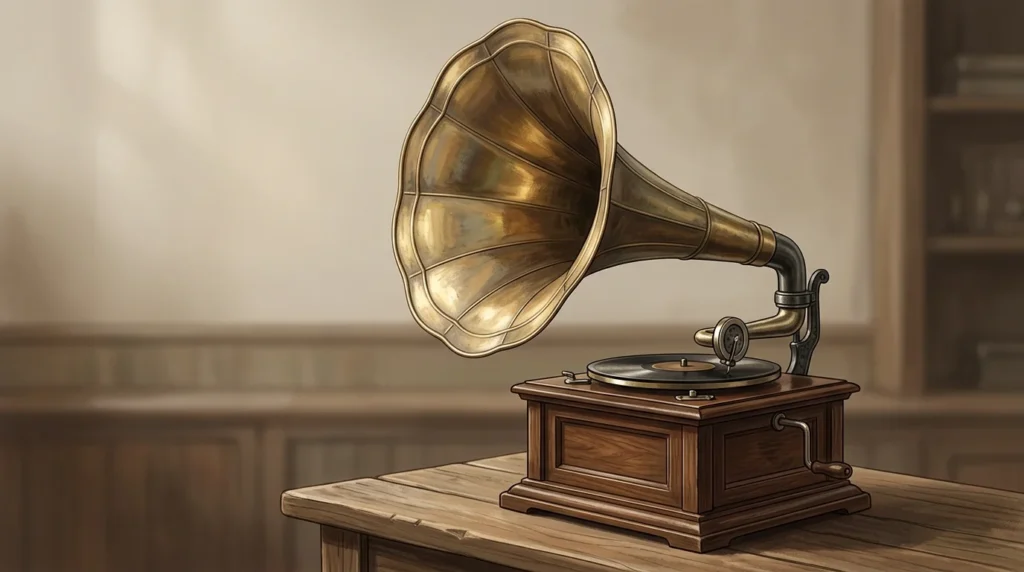

The closest synonyms for phonograph are record player and, in many contexts, gramophone. All three terms refer to devices associated with playing recorded sound, but their historical use and technical meanings can differ. A phonograph is historically associated with Thomas Edison’s sound-recording and playback invention, while gramophone became widely associated with disc-record playback, particularly in British English and historical contexts. Record player is a familiar modern term for a device that plays vinyl records.
The best alternative depends on whether you are discussing an antique machine, a historical invention, or a modern device used to play records.
What Are the Best Synonyms for Phonograph?
| Synonym or related term | Meaning | Best context |
|---|---|---|
| Record player | A device that plays recorded music from records | Everyday and modern usage |
| Gramophone | A historical term for a record-playing device, especially one using disc records | Historical writing and British English contexts |
| Turntable | The rotating platform and playback mechanism used for records; sometimes used for the whole device | Audio equipment and DJ contexts |
| Record player system | A complete setup for playing records | Modern audio equipment |
| Sound reproducer | A device or mechanism that reproduces recorded sound | Technical or historical descriptions |
| Audio playback device | A general device that plays recorded audio | Broad technical descriptions |
| Record-playing machine | A descriptive term for a machine that plays records | Explanatory or historical writing |
| Talking machine | An older, general term for early sound-recording and playback devices | Historical contexts |
Important distinction: These alternatives are not all exact synonyms. Record player is the most accessible everyday substitute, while gramophone often fits historical descriptions. Turntable can refer only to part of a complete record-playing system.
What Does Phonograph Mean?
A phonograph is a noun referring to a machine designed to record and reproduce sound. In historical usage, the term is especially associated with Thomas Edison’s invention, which used a stylus to trace sound vibrations onto a recording medium and reproduce them during playback.
Early phonographs used cylinders, while later sound-reproduction technology became strongly associated with disc records.
Example: The museum displayed an antique phonograph that could reproduce recorded voices.
The word can refer to the historical machine itself or, in broader usage, to a device that plays recorded sound. Its exact meaning depends on the period and context being discussed.
Is a Phonograph the Same as a Record Player?
Not always in a strict historical sense, although the terms overlap in everyday usage.
A phonograph often evokes an early sound-recording or playback machine. A record player generally refers to a device that plays records, particularly vinyl discs.
For a modern product description, record player is usually clearer. For an account of early sound technology, phonograph may be more historically appropriate.
Is a Phonograph the Same as a Gramophone?
The terms are closely related, and in some contexts they refer to much the same kind of device. Historically, however, they have different associations.
Phonograph is strongly associated with Edison’s early sound-recording invention. Gramophone became associated with disc-record playback and is especially familiar in British English and historical descriptions.
The distinction is not absolute in all historical writing, so the terms should be interpreted in context.
For more helpful explanations, check out our guide to For more helpful explanations, check out our guide to Commonly Confused English Words
Synonyms for Phonograph Explained in Detail
1. Record Player
Meaning: A device that plays recorded sound from a physical record, commonly a vinyl disc.
Record player is generally the most natural everyday alternative to phonograph when the intended device plays records.
Example: My grandfather still uses a record player to listen to his jazz collection.
Difference: A record player usually suggests a disc-playing device, whereas phonograph can refer to older sound-recording and playback technology, including cylinder machines.
Best context: Everyday conversation, modern music equipment, product descriptions, and discussions of vinyl records.
2. Gramophone
Meaning: A device used to reproduce sound from a record, especially a disc record in historical contexts.
Example: An antique gramophone stood beside the collection of historical records.
Difference: Gramophone often carries a historical or traditional association. In British English and some other varieties, it may be used more readily than phonograph when referring to an older record-playing machine.
Best context: Historical writing, museums, antique equipment, and descriptions of early disc-record technology.
3. Turntable
Meaning: A rotating platform on which a record sits while it is played. The term can also refer informally to a complete record-playing device.
Example: The DJ connected the turntable to a professional audio mixer.
Difference: A turntable may be only one component of a larger audio system. A complete record player may also include a tonearm, cartridge, amplification, and speakers, depending on its design.
Best context: Audio equipment, DJ setups, vinyl collecting, and technical discussions.
4. Sound Reproducer
Meaning: A device or mechanism that converts recorded information into audible sound.
Example: The curator carefully examined the sound reproducer from the early recording machine.
Difference: This is a broad descriptive term rather than a common everyday synonym. It may refer to a playback mechanism or device without identifying a particular historical design.
Best context: Technical descriptions, historical explanations, and discussions of sound technology.
5. Audio Playback Device
Meaning: A device that plays recorded audio.
Example: The archive uses several audio playback devices to preserve access to old recordings.
Difference: This term is much broader than phonograph. It can include record players, cassette players, CD players, digital music players, and other equipment.
Best context: General technical writing, audio archives, and explanations where the exact device is not important.
6. Record-Playing Machine
Meaning: A machine designed to play sound recordings stored on records.
Example: The exhibition included a record-playing machine from the early twentieth century.
Difference: This descriptive phrase communicates the function without necessarily identifying the machine’s historical type. It is useful when a reader may not recognize the word phonograph.
Best context: Accessible historical writing, museum labels, and explanatory descriptions.
7. Talking Machine
Meaning: An older general term for machines that reproduced recorded sound, particularly early devices associated with recorded voices and music.
Example: The advertisement promoted a talking machine that could entertain the entire household.
Difference: Talking machine is a historical expression and is not normally used as the name of a modern audio product. It can refer to early sound-reproduction devices more broadly than a specific phonograph model.
Best context: Historical documents, period advertising, and writing about early home entertainment.
Also Read: Synonyms of Tendrils
Phonograph Synonyms by Context
The right term depends on what you want readers to understand about the device.
For Everyday Conversation
Use record player when discussing a device that plays vinyl records.
For example:
- “My parents bought an old phonograph.”
- “My parents bought an old record player.”
The second sentence sounds more familiar to many contemporary readers if the device plays ordinary records.
However, if the machine is an early cylinder-based device, phonograph may be the more accurate term.
For Historical Writing
Use phonograph, gramophone, or talking machine according to the machine and historical period being described.
- Phonograph: Particularly appropriate when discussing Edison’s invention and cylinder-based recording technology.
- Gramophone: Often appropriate for historical disc-record playback machines.
- Talking machine: Useful when describing early sound-reproduction devices in general or reproducing the terminology of a historical source.
Example: The collection included an early phonograph and a later gramophone used for playing disc records.
This wording helps distinguish related devices without treating the names as perfectly interchangeable.
For Technical Audio Writing
Use turntable when the rotating record mechanism is the focus, and use audio playback device when referring to a wider category of equipment.
Example: The technician replaced the turntable’s cartridge before testing the playback system.
Calling the cartridge or turntable a phonograph would be imprecise if the sentence specifically concerns an individual component.
For Museums and Antique Collections
A descriptive term can help readers understand an unfamiliar object.
Example: The museum displayed an antique phonograph beside a collection of original recordings.
If the exact device is known, identify it by its historically appropriate name. If its type is uncertain, early record-playing machine may be a useful descriptive alternative without making an unsupported historical claim.
For more helpful explanations, check out our guide to For more helpful explanations, check out our guide to Commonly Confused English Words
How to Choose the Right Synonym for Phonograph
1. Identify the Type of Device
Before replacing phonograph, consider whether the device plays cylinder recordings, disc records, or modern vinyl records.
A historical machine may be best called a phonograph or gramophone, depending on its design. A contemporary vinyl device is usually called a record player.
2. Match the Term to Your Audience
For general readers, record player is usually easy to understand. For readers interested in the history of recorded sound, phonograph and gramophone may communicate more specific historical associations.
For example:
- General: “She inherited an antique record player.”
- Historical: “The museum preserved an early phonograph.”
The first prioritizes accessibility; the second emphasizes historical significance.
3. Avoid Using Turntable for Every Part of the System
A turntable is often a component of a record-playing setup, although the word can also be used informally for a complete unit.
If you mean the entire device, record player may be clearer. If you mean the rotating platform or a DJ’s equipment, turntable is more precise.
4. Use Broad Terms Only When Specificity Is Unnecessary
Audio playback device is useful when the type of equipment does not matter. However, it loses the historical and mechanical specificity of phonograph.
Compare:
- Specific: “The antique phonograph reproduced sound from a cylinder.”
- Broad: “The audio playback device reproduced recorded sound.”
The second sentence is understandable but omits the type of machine and its recording format.
Common Mistakes When Choosing Synonyms for Phonograph
Assuming Phonograph and Gramophone Always Mean Exactly the Same Thing
The terms overlap, but their historical associations and usage can differ. Use the name that best fits the particular machine and historical context.
Treating a Turntable as Always Equivalent to a Record Player
A turntable may refer to the rotating mechanism or the complete unit, depending on context. A record player more clearly names the device used to play records.
Using Audio Playback Device When a Specific Name Matters
The phrase audio playback device includes many types of equipment. It is not a precise substitute when the article is specifically about an antique phonograph or gramophone.
Calling Every Historical Sound Device a Phonograph
Early sound-recording and playback technology included different mechanisms and designs. The term phonograph is strongly associated with particular historical inventions, so a broader expression such as early sound-reproduction device may be safer when the exact type is unknown.
Assuming Phonograph Means Only a Modern Vinyl Player
The word has a significant historical association with early sound-recording and reproduction. When discussing a modern vinyl device, record player is often the clearer term.
Also Read: Synonyms for Nation
Antonyms and Related Vocabulary
Phonograph names a type of device, so it has no direct, standard antonym. Related vocabulary can still help clarify how it differs from other equipment.
| Related term | Meaning | How it differs from phonograph |
|---|---|---|
| Recorder | A device that captures or stores sound | Emphasizes recording rather than playback |
| Microphone | A device that converts sound into an electrical signal | Captures sound; it does not independently play recordings |
| Speaker | A device that converts an audio signal into audible sound | Produces sound as part of a playback system |
| Headphones | Devices worn over or in the ears to hear audio | Deliver sound privately rather than reading records |
| Digital music player | A device that plays digitally stored audio | Uses digital files or data rather than a physical record |
| Cassette player | A device that plays audio stored on cassette tape | Uses magnetic tape rather than a record disc or cylinder |
These terms are related to sound recording or playback, but they are not synonyms for phonograph. The best choice depends on the equipment’s actual function.
Frequently Asked Questions
What is the most common synonym for phonograph?
Record player is often the most familiar everyday alternative, particularly when referring to a device that plays vinyl records. Gramophone is also closely related, especially in historical contexts.
What is the difference between a phonograph and a gramophone?
Both terms refer to sound-reproduction devices, but phonograph is strongly associated with Edison’s early recording and playback invention, while gramophone is commonly associated with disc-record playback. Their historical usage overlaps.
Is a turntable the same as a phonograph?
Not always. A turntable is the rotating platform and playback mechanism used with records, although the term can informally refer to a complete record-playing unit. Phonograph has broader historical associations.
What is an old-fashioned word for record player?
Gramophone is a familiar old-fashioned term for a record-playing device. Talking machine is another historical expression for early sound-reproduction equipment.
What is the opposite of phonograph?
There is no standard antonym for phonograph. A recorder performs a related but different function because it captures sound rather than primarily reproducing recorded sound.
If you want to learn about another commonly confused pair of English words, check out our guide to Synonyms for Phonograph
Conclusion
The closest synonyms for phonograph include record player and gramophone, but the best choice depends on the machine’s design, historical period, and intended audience. Record player is generally suitable for everyday references to vinyl equipment, while gramophone often fits historical disc-playing devices. Turntable is more precise when the rotating mechanism or DJ equipment is the focus, and audio playback device is a broader technical description.
Choose the term that accurately describes the device rather than treating every related audio term as interchangeable.


Pingback: Synonyms for Essentials: 15 Words and Their Meanings
Pingback: Synonyms for Steak: Meaning, Alternatives, and Usage
Pingback: Hidden Treasure Synonyms: Meaning and Alternatives